
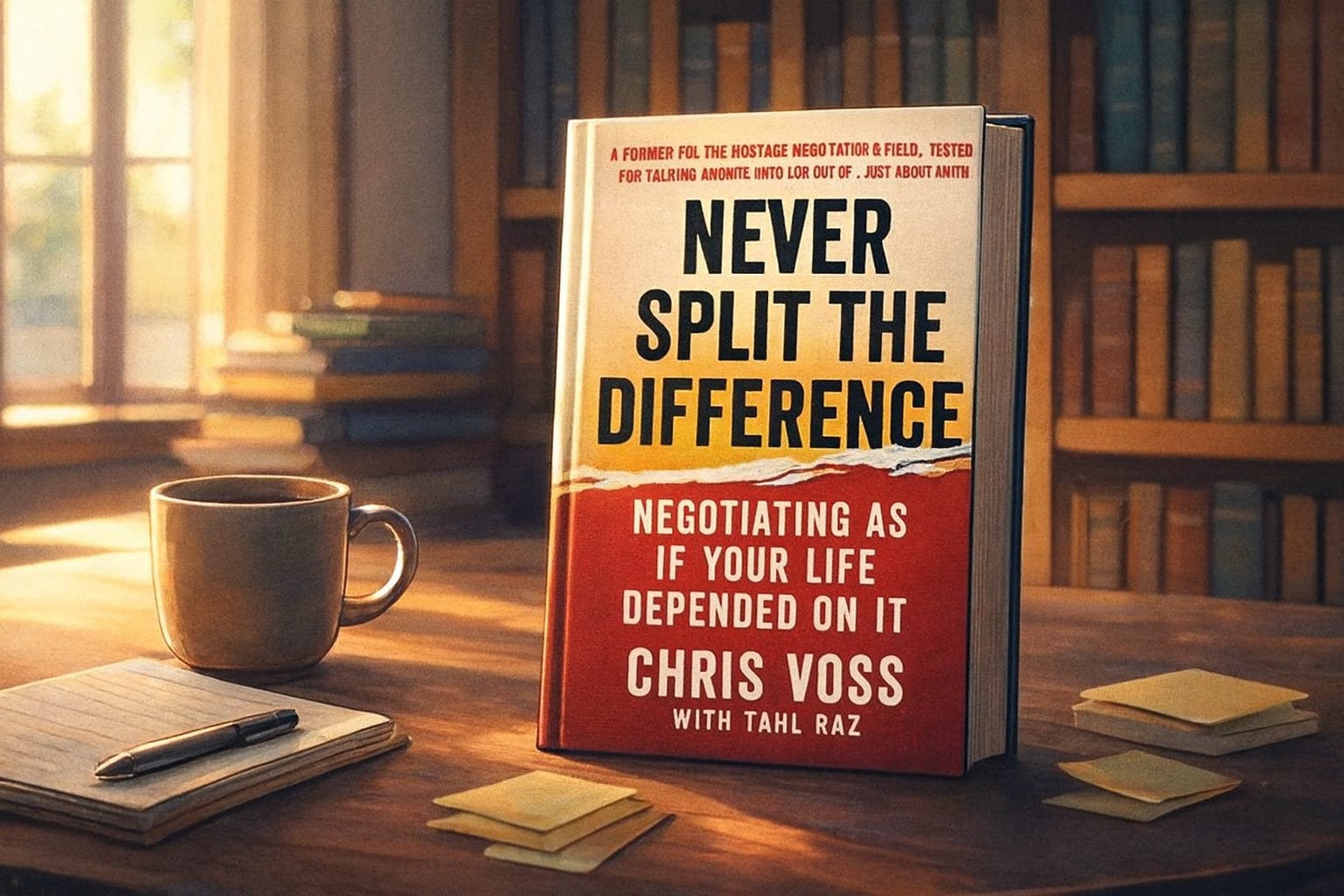
Never Split the Difference by Chris Voss: Book Summary & Notes
Dive into high‑stakes negotiation wisdom from an ex‑FBI hostage negotiator. These lessons are applicable to business, life and every conversation you have.

Chris Voss is a former lead international hostage negotiator for the Federal Bureau of Investigation (FBI) who handled life‑and‑death scenarios before founding The Black Swan Group.
In this book, he shares the tactics that were forged in extreme-pressure situations. He illustrates how these same principles can be applied to everyday negotiations, from salary talks to team leadership, revealing the power that emotional intelligence and listening have over brute logic and lectures.
🚀 The Book in 3 Sentences
Voss argues that many negotiation models fail because they treat people as rational when, in actuality, people are often emotional, impulsive, and fear‑driven.
He introduces techniques like tactical empathy, mirroring, labelling, and asking calibrated “how” or “what” questions to uncover real motives and steer outcomes.
Instead of seeking compromise (“splitting the difference”), Voss teaches how to shape the other side’s reality and craft agreements that are better than halfway.
🎨 Reflections
It was interesting to hear some of the scenarios that forged certain principles.
The anecdotes from hostage negotiations pack tension, but Voss swiftly translates them into everyday value, whether you’re negotiating a raise, dealing with a difficult team member, or managing family conflict.
It shifts the paradigm: negotiation is about influence and connection, not just deals.
☘️ Influence
This is something that has already come up in Coaching Athletes to be their Best (Stephen Rollnick).
We often assume that lecturing, facts and/or logic are enough to influence behaviour change, but this book adds credence that people aren’t influenced by these things.Behaviour change is often emotional and intrinsically driven. This book has allowed me to see the power of “NO”.
It has cemented the idea of deliberate conversations, such as changing “you’re right” to “that’s right”, because the latter signals genuine understanding.Additionally, it has allowed me to see how everyday interactions are mini-negotiations, where attentiveness and empathy provide leverage.
✍️ My Top 3 Quotes
“The person who feels safe, understood and heard will listen and open up more freely.”
“Mirror and label emotions to diffuse them: ‘It sounds like you’re upset about this process…”
“When you’ve got your counterpart to say ‘That’s right,’ you’ve achieved alignment—not before.”
📒 Key Concepts & Notes
🎯 Tactical Empathy
This is the foundation of Voss’s approach.
It’s not about agreeing or being soft. Instead, it’s about actively trying to understand the emotions, motivations, and worldview of the person across from you.
❝ Tactical empathy is understanding the feelings and mindset of another in the moment and also hearing what is behind those feelings. ❞
Tactical empathy builds trust and lowers defensiveness, especially in tense environments. It invites openness because the other person feels seen.
Example: Before asking for a salary raise, you might say:
“It seems like the company has had to make some tough decisions recently, especially in budgeting. I understand that…” — before introducing your value and request.
🔄 Mirroring
Mirroring is simple — repeat the last 1–3 words (or key phrases) your counterpart said, with a calm tone and upward inflection.
Then stay silent. This forces the other person to expand on what they said. It creates a rhythm, makes people feel heard, and buys you time to think.
Example:
Colleague: “I just don’t think that plan makes sense right now.”
You: “Doesn’t make sense right now?” (pause)
Them: “Yeah, because we’re already behind on the budget, and we’d need external help…”
🏷 Labelling
This is the act of naming emotions or perspectives to show understanding, even if you’re unsure. Labels begin with:
“It seems like…”
“It sounds like…”
“It looks like…”
Labelling helps people feel validated and calms their emotional brain. It also stops negative emotions from escalating.
Example in coaching:
“It seems like you’re frustrated by the changes in the lineup.”
This opens the door for truth without confrontation.
🛑 The Power of “No”
Contrary to most negotiation advice, Voss teaches that “No” is not rejection — it’s protection. When people say no, they feel safe, in control, and less pressured.
❝ Saying ‘no’ often gets us closer to agreement than ‘yes’ ever could. ❞
Example:
Instead of asking, “Do you have five minutes to talk?”, ask:
“Is now a bad time?”
This gives them control and usually gets a more open response.
✅ Trigger “That’s Right”
The moment someone says, “That’s right,” is the moment they feel truly understood and are more open to alignment.
Avoid “You’re right,” which is often just a polite way to end the conversation.
How to trigger it: Recap their story, struggles, and viewpoint in a way that shows deep listening.
Example:
“You’ve had to manage tight deadlines, unclear expectations, and now you’re being asked to change your workflow again. That would overwhelm anyone.”
“That’s right.”
🧠 Calibrated Questions
Open-ended questions that begin with “How” and “What” are less threatening and encourage problem-solving.
These questions avoid yes/no answers and keep the other party psychologically engaged.
Examples:
“What about this is important to you?”
“How would you like to proceed?”
“What’s the biggest challenge you see here?”
Calibrated questions create the illusion of control while guiding the conversation.
🔍 The Illusion of Control
When you ask questions that force others to think and solve, they feel in control, even if you’re steering. This is key in negotiation and feedback.
Bad question: “Why haven’t you approved this yet?”
Better question: “What’s the biggest obstacle to moving forward with this?”
🔄 The Ackerman Model (For Bargaining)
This is Voss’s step-by-step system for price negotiation:
Set your target price (goal).
Start at 65% of your target.
Make 3 incremental raises: 85%, 95%, then 100%.
Use empathy and calibrated questions throughout.
Throw in a non-monetary item at the end (something they value but costs you little).
Why it works: It uses psychology, anchoring, and concessions to get to your number while appearing flexible.
⏳ Deadlines Are Often Illusions
Voss warns that most deadlines are artificial pressure points used to force decisions.
Don’t panic or rush. Instead, slow things down. Ask:
“What happens if we don’t reach an agreement by then?”
This reveals if the deadline is real or a bluff.
🦢 Spotting Black Swans
These are unknown pieces of information that can shift the entire negotiation.
Most people miss them. Voss encourages deep listening, curiosity, and patience to uncover them. Black Swans are discovered when people feel safe enough to share.
Example: You might learn that your client is under pressure from a board member to make a quick decision. This becomes leverage you wouldn’t have had otherwise.
Within a coaching context, one of your players is unhappy with his current role.
His energy is draining due mainly to his dissatisfaction. Through a casual conversation with another player, you hear that the player in question deeply values being a team captain.
That’s a black swan moment. It’s not about the captaincy. It’s about leadership and recognition, rather than minutes or points.
This new information can change everything in conversations moving forward.
🧠 Insight & Application Corner (Life • Leadership • Coaching)
In Coaching/Team Settings:
When giving feedback, mirror and label the athlete’s feelings before you add your own viewpoint.
“It seems like you felt boxed in the last set…” opens up more than immediate correction.In Leadership:
Use “What’s the biggest concern for you here?” to uncover resistance instead of starting with your agenda.In Personal Life:
When conflict arises (e.g., with family or friends), resist rushing to fix the problem. It often helps just to say, “It seems like you’re feeling ignored…” Then pause.In Negotiation or Stakeholder Work:
Prepare a “one‑sheet” of key issues and likely objections, then structure from question to answer. Avoid lectures.In Everyday Communication:
Recognise that your counterpart is often not fighting you. They’re protecting something. Listen for why, not just what.
🔗 Connections and Curiosities
The book offers a strong contrast to more formulaic negotiation texts like Getting to Yes—Voss criticises them for being too rational and less applicable in emotionally high‑stakes.
Complements books like Drive (Daniel Pink) and The Culture Code (Daniel Coyle), which emphasise psychology, emotions and systems over tactics alone.
Pairs with Deep Work—both highlight focused listening and presence as sources of power.
Future reading: Ask For It (Wharton professors) or Difficult Conversations for deeper dives into dialogue and negotiation in varied settings.
Love this book as well, start these up again and I will definitely subscribe. These are so helpful!