


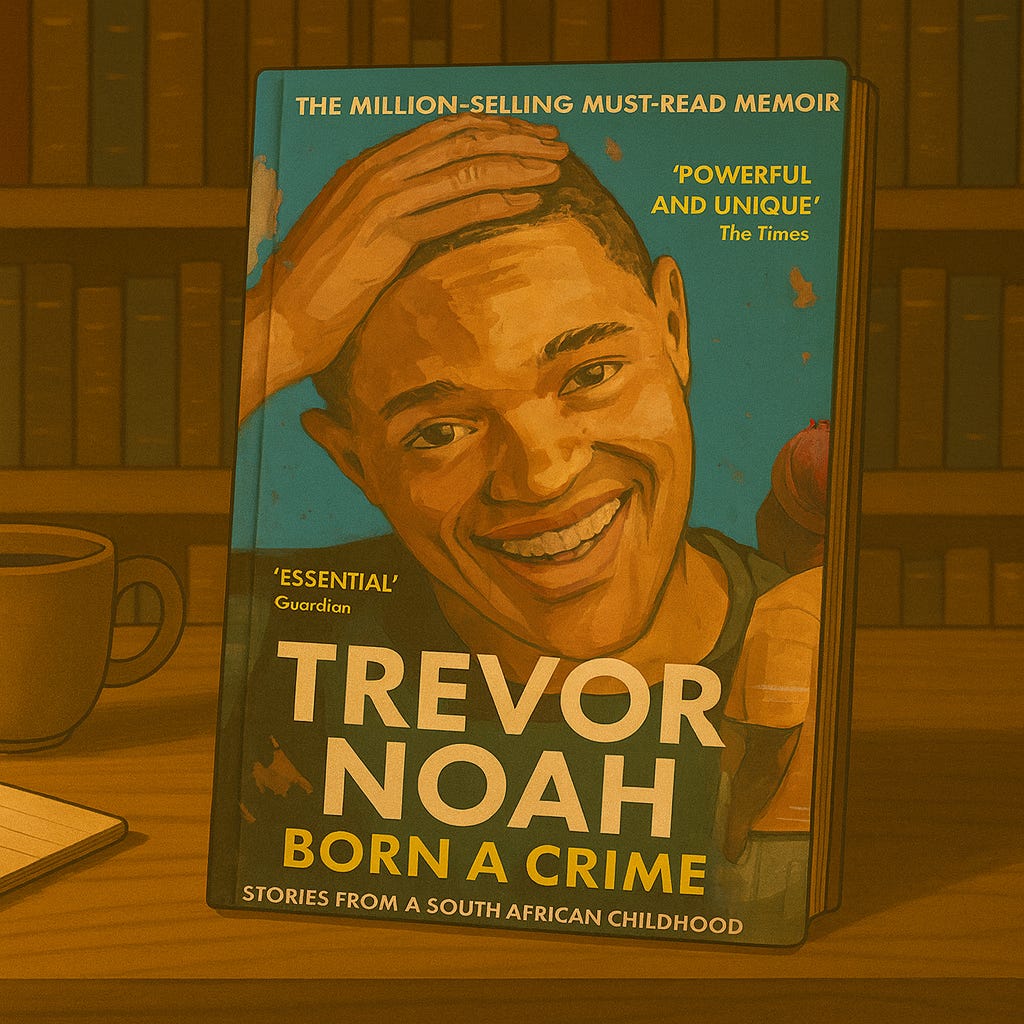
Trevor Noah is an internationally acclaimed comedian and former host of The Daily Show, whose mixed-race heritage under apartheid made his very existence illegal.
In his book, he shares his journey and talks about how he turned his pain into purpose, showing how humour, self-awareness, and inner strength can transcend division and shape leaders.
🚀 The Book in 3 Sentences
Born during apartheid as the child of a Black Xhosa mother and a white father, an illegal combination, Trevor grew up straddling racial, social, and cultural divides.
His mother’s fierce love, strict values, and commitment to education shaped his resilience and moral compass amid poverty, abuse, and danger.
With wit and humility, Noah weaves stories of survival, identity, and transformation, revealing how belonging is built on empathy, learning, and daring to belong to more than one world.
🤔 Reflections
Born a Crime is part-laugh, part-heartbreak, and fully compelling.
Each anecdote (and Trevor does a great job at delivering them on time), whether about navigating segregation, entrepreneurship via bootleg CDs, or his mother’s schoolhouse rebellion, carries the humour and heart of a storyteller who survived with humour and soul.
It reconnects us to the power of curiosity, grit, and love in defiance of systems built to divide.
👤 Who Should Read It?
Coaches seeking lessons in resilience, humour, and cross-cultural empathy
Leaders wrestling with identity, belonging, or rebuilding
Young people grappling with systemic barriers or complex identities
Anyone who believes in the power of storytelling to connect and heal
☘️ How the Book Changed Me
I don’t know if the book actually changed me in any way, but I enjoyed reading Trevor’s story, relating to the cross-cultural divides that I have also experienced and how Trevor weaves humour into his beautiful storytelling manner.
✍️ My Top 3 Quotes
“I was born a crime, but the only way to survive was to learn how to make you laugh.”
“You can only dream what you can imagine.”
“Give a man a fish and you feed him for a day; teach a man to fish and you feed him for life, but give him a fishing rod, and he can feed generations.”
📒 Key Concepts & Notes
🧠 Identity Is a Choice
Mixed-race in apartheid meant no home. Noah used language, humour, and curiosity to write his own identity.
Identity gives purpose, not permission. As you lead, encourage your players to explore what shapes them, whether it is their culture or their family and then teach them to stand strong in their full selves.
🛠️ Resilience Through Resourcefulness
Poverty, crime, and segregation forced Noah to adapt, selling CDs, switching languages, and learning how to hustle on the streets.
Resilience isn’t about talent. It is about adaptability. Applied on the court, it is about putting your players in situations where they have to adapt constantly in order to complete the activity or the task.
It matters because the game, like life, is unpredictable. The ones who adapt quickly increase their chances of success.
🔁 Love and Discipline Are Allies
His mother combined toughness with empathy, sending him to Catholic school, protecting him from violence, and grounding him in faith.
Tough love builds growth from a place of safety. It doesn’t always mean that toughness comes first. Sometimes, the love has to be felt before the toughness can be displayed.
Balance how you hold your players or your teammates accountable. Connect before you correct. Care before you teach. People before the performance.
🔁 Storytelling Connects Us
Noah’s humour and storytelling brought people across divides together. This is something that I have tried to learn to be better at. It is still a work in progress.
Shared stories spark belonging.
Storytelling is one of the earliest forms of communication. Tribes gathered around fires, as the elders shared stories of the brave and the fallen. Politicians from the earliest days have used stories to influence their followers. Religious scripts use stories to share values and desirable attributes. Learn how to use it as a coach or a leader.
Invite players to share stories from outside sport, tough moments, cultural traditions, and personal victories.
🏀 Coaches’ Corner: 5 Takeaways to Use This Week
Language as a Bridge
Invite each player to teach a word or phrase from their native language. Celebrate the richness of identity within the team. While it may sound corny, Coach Popovich (San Antonio Spurs) found ways to connect and teach outside of basketball, including celebrating the richness of each person’s culture on his team.
Host a “Storytelling Circle”
Once a week, ask for a personal anecdote about someone who inspired them, a cultural memory, or a moment that changed their life.
Design Resourcefulness Challenges
During practice, set unexpected constraints (e.g., non-dominant hand only). Debrief how resourcefulness helped win the drill. This is in align with the CLA and also in teaching players to be adaptable.
Highlight “Tough Love” Moments
Share examples where discipline and care worked together, then ask players to reflect on times they’ve given or received both. An underrated part of development is also teaching players how to have positive conflict.
Use Humour to Disarm Tension
When practice or games get heated, introduce a funny ritual or inside joke to reset the emotional tone, just like Noah does.
🔗 Connections and Curiosities
Links closely with resilience narratives like Man’s Search for Meaning (Frankl) and The Rise of Superman (Kotler), where adversity frames growth.
Echoes themes in Ikigai and Atomic Habits. Identity, purpose, and small actions shaping a meaningful life.
Adds depth to The Culture Code, stories and shared backgrounds fuel belonging.
Inspiration for future reads: The Inner Game of Tennis (Gallwey) for mental clarity, Educated (Westover) for education as liberation, and Emergent Strategy (B. Brown) for adaptive leadership.